

Judge Ketanji Brown Jackson speaks during her Senate Judiciary Committee confirmation hearing on March 23.
Julia Nikhinson/Bloomberg via Getty Images
The Senate Judiciary Committee on Monday deadlocked in its vote to recommend Supreme Court nominee Ketanji Brown Jackson. All 11 Democrats voted to report Jackson’s nomination favorably, while all 11 Republicans on the panel voted for an unfavorable recommendation in the first tie vote since Justice Clarence Thomas was confirmed in 1991.
The full Senate will now have to vote to discharge her nomination from the committee without a recommendation.
Historically, the committee has allowed nominees — including Thomas — to advance to the Senate floor without a recommendation. This time Senate Majority Leader Chuck Schumer will have to call for a vote to release her nomination, a procedure that hasn’t been invoked since the 19th century.
A tie vote “slows us down on the floor for a few hours, but it doesn’t stop us,” Sen. Dick Durbin, chair of the Judiciary Committee, said last week.
If confirmed, Jackson, 51, will be the first Black woman on the Supreme Court.
When will the full Senate vote on Jackson’s nomination?
Schumer made a motion Monday afternoon to discharge Jackson’s nomination from the Judiciary Committee. After up to four hours of debate, the motion can be brought to a vote, likely Monday evening.
Should that motion pass, Jackson’s final confirmation vote by the full Senate would happen Thursday or Friday. Durbin has said he hopes to have a Senate vote by Friday, before the chamber takes a spring recess. That would be 43 days after Biden announced her nomination on Feb. 25.
Since the 1970s, the average length of time between nomination and final Senate vote has been about 68 days, according to the Congressional Research Service. After her nomination in 2020, Justice Amy Coney Barrett was seated in a record 27 days.

Jackson met with Senate Minority Leader Mitch McConnell in advance of her Senate confirmation hearings.
Drew Angerer/Getty Images
Could Republicans block Jackson’s confirmation?
Once a vote is before the full Senate, only 51 yes votes out of 100 — a simple majority — are needed to confirm Jackson to the Supreme Court. The upper chamber is split 50-50 between Democrats and Republicans, but Sen. Susan Collins, a Republican from Maine, has already said she will vote to approve Jackson, and it’s possible others will join her.
Lindsey Graham, a Republican from South Carolina who supported Jackson’s nomination to the US Court of Appeals, has said he will oppose her bid for the high court,
There’s the possibility some Democrats could vote against Jackson, but Sen. Joe Manchin of West Virginia, who has shown a willingness to break with his party before, said he plans to back her confirmation.
“I am confident Judge Jackson is supremely qualified and has the disposition necessary to serve as our nation’s next Supreme Court Justice,” he said in a statement Friday.
What do we know about Jackson?
Jackson was born in Washington, DC, in 1970 and raised in Miami. Her father, Johnny, was an attorney for the Miami-Dade School Board while her mother, Ellery, was principal at New World School of the Arts in downtown Miami.
Jackson’s maternal uncle, Calvin Ross, was Miami’s police chief from 1991 to 1994. Her younger brother, Ketajh Brown, served with the Baltimore Police Department from 2001 to 2008.
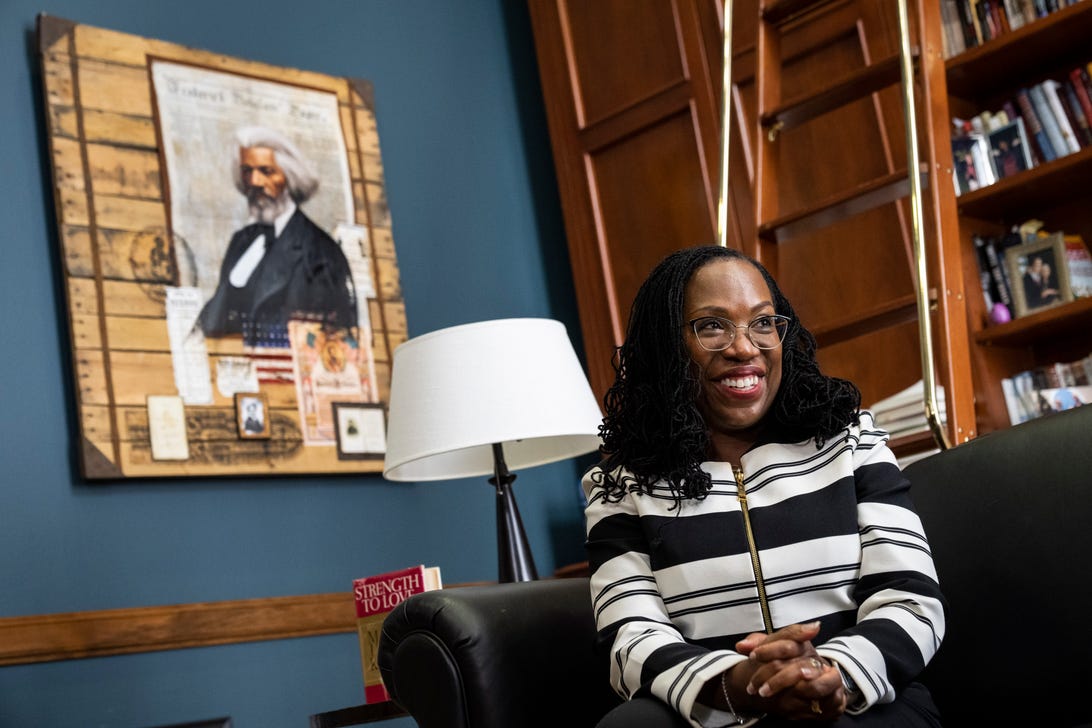
Judge Jackson in Sen. Cory Booker’s Capitol Hill office.
Drew Angerer/Getty Images
After receiving both her bachelor’s and law degrees from Harvard, Jackson worked as a public defender and in private practice. She also served as a US district judge in the District of Columbia and on the US Sentencing Commission.
Announcing her nomination, Biden said she was “one of our nation’s brightest legal minds and will be an exceptional Justice.” He praised her as a “proven consensus builder” with a distinguished resume as both an attorney and a jurist.
At the same briefing, Jackson credited her father with inspiring her passion for the law. “Some of my earliest memories are of him sitting at the kitchen table reading his books,” she said. “I watched him study, and he became my first professional role model.”
What could be on the docket for Jackson as a justice?
So long as conservative justices hold a majority on the bench, Jackson wouldn’t swing the court further to the left if confirmed. But she could join in ruling on several hot-button issues that have been making their way through the judiciary.
In January, the Supreme Court agreed to hear an appeal challenging the constitutionality of the Federal Trade Commission, which is charged with enforcement of antitrust laws and promoting consumer protection. Arguments likely won’t be heard until the next term, which starts in October.
One case Jackson won’t hear is a suit challenging affirmative action practices at Harvard University, where she earned both her undergraduate and law degrees and serves on the Board of Overseers. Jackson testified Wednesday that, if confirmed, she would recuse herself from the case.