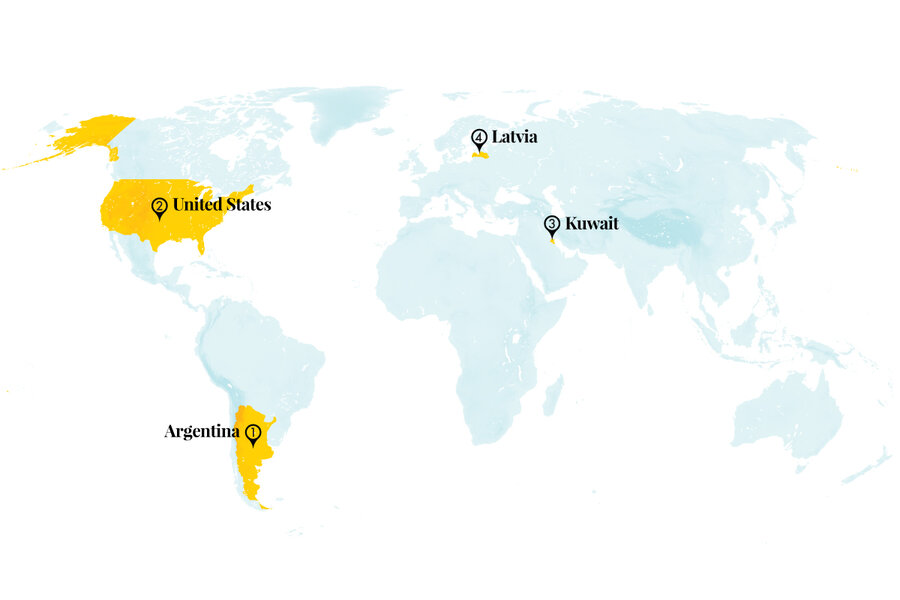
Success in bringing back populations of one species can also spawn attempts to boost others, using similar methods. Also on the environment, batteries are being recycled into fertilizer. And in human rights news, Latvia pays compensation to communities for the Holocaust, and Kuwait overturns an anti-transgender law.
1. Argentina
Two giant anteaters paved the way for other successful reintroduction programs in Argentina’s Iberá Wetlands. Scientists weren’t sure what to expect when they released a pair of giant anteaters – affectionately named Ivotí Pora and Preto – into the wilderness of the Rincón del Socorro reserve in 2007. Hunting and agriculture had eradicated the species in the wild decades earlier. This pair not only survived, but also had seven cubs. “They were fighters,” says veterinarian Gustavo Solís from the Rewilding Foundation, which runs a rescue center for anteaters. Since then, the foundation has rescued over 120 anteaters and released 93 across four sites, with help from provincial governments, national parks, zoos, and universities.
Why We Wrote This
At face value, species reintroductions mean preservation of unique life. But in one case in our progress roundup, animals were also key to a comeback of the ecosystem itself.
When young anteaters are rescued and brought to the center, they’re bottle-fed until they can switch to a normal diet of worms and termites. The animals must meet certain requirements before they can leave the facility, such as weight, self-reliance in feeding and shelter, and the ability to use their tail for self-protection. They then spend a month in a pre-release pen that mimics the wild environment, where they are fitted with monitoring devices. Conservationists have organized educational events to help locals better understand the species that went extinct in the 1960s. Using this model, the foundation has also reintroduced Pampas deer, jaguars, and red-and-green macaws back to the wild.
Mongabay
2. United States

Bison helped resurrect a section of the American prairie, offering hope for similar ecosystems globally. Before settlers altered the landscape, millions of bison lived among tall perennial grasses on a tract of land that stretched from Texas to Canada. Today, less than 5% of the tallgrass prairie remains. A strategy combining bison grazing with seasonal fires has restored 40,000 acres of land on the Joseph H. Williams Tallgrass Prairie Preserve in northeast Oklahoma.
Cattle ranching had destroyed the ecosystem due to cramped overgrazing before bison were reintroduced in 1993. Now the land is managed by The Nature Conservancy, which focuses on restoring the surprising amount of biodiversity native to the prairie. The team started with North America’s largest mammal since the free-ranging bison spend much of their time grazing, keeping certain plants in check and allowing others to flourish. The original herd of 300 has since grown to 2,500. “They’ve never been domesticated, and one of our policies is to respect as best we can the wildness of that species,” explained Sam Fuhlendorf, a professor at Oklahoma State University. “We’ve tried to understand the way this system would have operated historically and restore it as closely as possible.” Healthy tallgrasses now cover the land, helped by controlled fires that allow for natural regrowth. Experts say the technique could also work on cattle ranches.
PBS Terra
3. Kuwait
Kuwait’s constitutional court overturned a law that violated the right to personal freedom and was used to prosecute transgender people. Article 198 had criminalized “imitation of the opposite sex” since 2007 and gave authorities leeway to stop or arrest individuals whose appearance was deemed not to match the gender on their identification cards. Human Rights Watch interviewed 40 transgender women in Kuwait in 2011, and 39 said they had been arrested at least once under Article 198. Activists say police have been known to harass and assault transgender people after detaining them.
Maha al-Mutairi, a transgender social media influencer from Kuwait, spoke in 2019 about her experience being detained under Article 198 for seven months, then beaten and raped by officers. The videos stirred criticism of the law from around the world. “Article 198 was deeply discriminatory, overly vague and never should have been accepted into law in the first place,” said Lynn Maalouf, Amnesty International’s deputy director for the Middle East and North Africa, who is pushing for the law to be fully repealed by the National Assembly but described the decision as a “major breakthrough.”
The New York Times
4. Latvia
Latvia passed a restitution bill to compensate Jewish communities for property losses incurred during World War II. Around 90% of the nation’s Jewish population was killed during the Holocaust, and hundreds of buildings were expropriated by the state in the Soviet era. The bill pledges €40 million ($45 million) to reimburse Holocaust survivors for lost property as well as refurbish community buildings and support cultural projects. The amount was determined by calculating the current assessed value of around 250 formerly Jewish community buildings, and took nearly two decades to negotiate.

“Finalizing this process demonstrates that even 77 years after the end of the Holocaust, it is never too late for justice,” said Arkady Sukharenko, chairman of the Council of Jewish Communities of Latvia, which represents the country’s 10,000 Jewish residents. Since 1952, Germany has contributed around $90 billion to support Holocaust survivors around the world, and recently agreed to contribute another €647 million ($716 million) to fund continued social services for these individuals. While the Latvian legislation affirms the state was not responsible for the atrocities committed under Nazi occupation, the government saw the step as its “moral obligation,” said Martins Bondars, chairman of the parliamentary budget committee. “Only a country that is able to deal with its past has a future.”
Deutsche Welle, The New York Times, Associated Press
World
Dead batteries are taking on new life as plant fertilizer in a step toward a more circular economy. Alkaline batteries are made in part using toxic substances, but that doesn’t mean useful materials can’t be repurposed. In fact, two micronutrients essential to plants (zinc and manganese) make up around 50% of a battery’s weight. Companies have developed methods to extract these chemicals, converting them into fertilizers.
For Finnish firm Tracegrow, the process starts by crushing alkaline batteries into “black mass.” Powerful magnets then remove ferrous metals from the mixture, but toxic metals like nickel remain. Through a patented leaching process, the mass is liquefied, microplastics and graphite are filtered out, and nickel and cadmium are removed and collected for reuse. When the process is complete, what’s left is a safe and environmentally friendly fertilizer that has shown positive results when tested on crops like wheat, barley, oats, tomato, and avocado in Finland, England, Italy, the United States, and other countries. Battery recycling company Envirostream is working on a similar process in Australia.
EuroNews